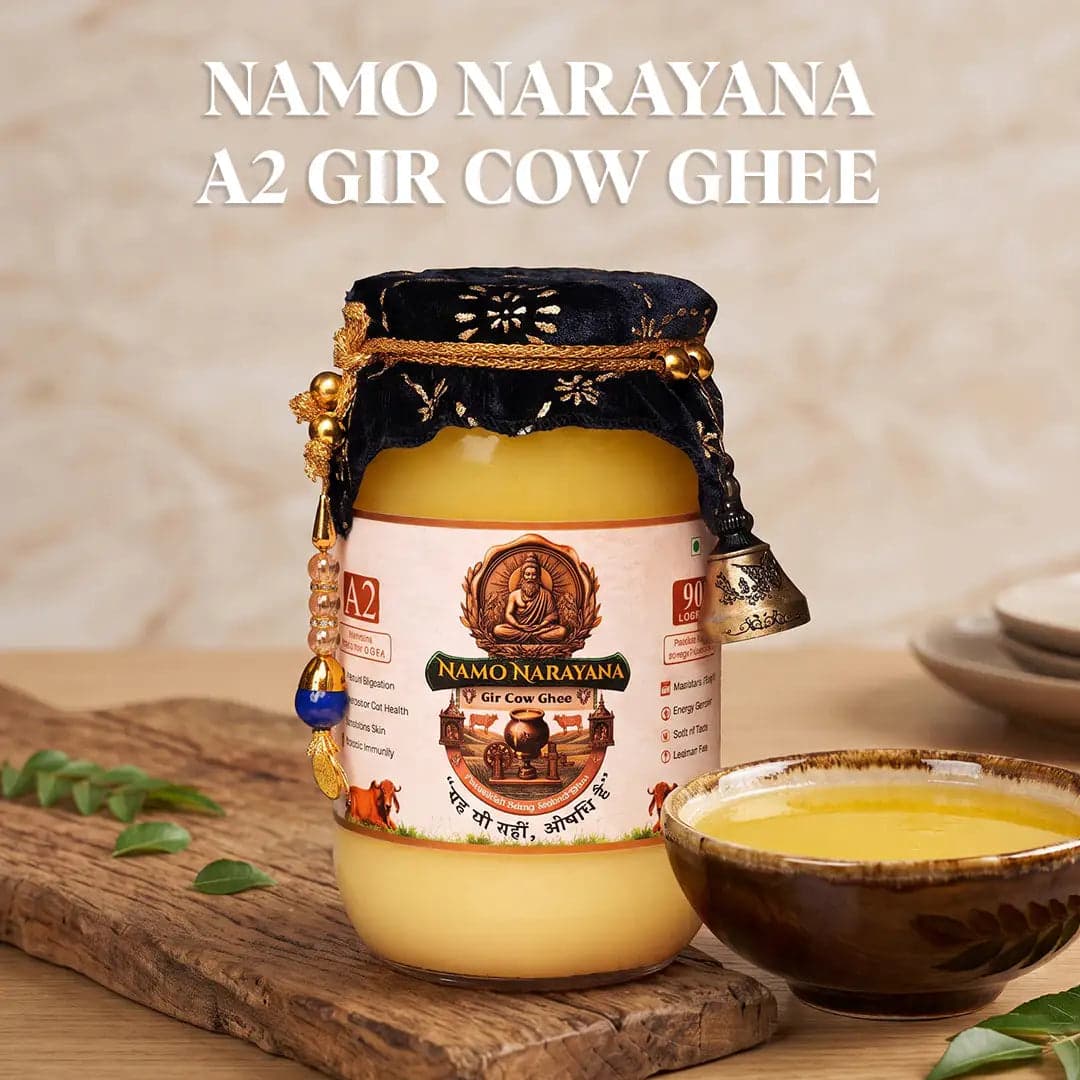
To understand why premium desi cow ghee carries a higher price than mass-market brands, one must differentiate between source milk protein and extraction method:
1. The A2 Beta-Casein Difference
Native Indian hump cattle breeds (Bos indicus), including the renowned Gir cow of Gujarat, produce milk containing the pure A2 beta-casein protein. In contrast, Western European cross-breeds (Holstein Friesian, Jersey) possess an amino acid mutation that yields A1 beta-casein.
When digested, A1 protein releases a peptide known as BCM-7 (Beta-casomorphin-7), which has been linked in medical literature to abdominal bloating, gut inflammation, and digestive intolerance. Pure A2 milk products release no BCM-7, making A2 ghee soothing to the intestinal lining and readily digestible even for individuals sensitive to regular dairy.
2. The Traditional 5-Step Bilona Method
Most cheap supermarket ghee is made by skimming raw cream (Malai) from milk with electric separators and directly boiling it. This takes only 10-12 litres of cheap milk per litre of ghee, but leaves behind heavy lactose and lacks medicinal aroma.
Namo Narayana adheres strictly to the ancient Vedic Bilona procedure:
1Slow Boiling
Fresh whole A2 Gir cow milk is boiled slowly
2Curd Culturing
Milk is converted into whole Dahi overnight
3Bilona Churning
Bi-directional wooden churning separates Makkhan
4Slow Simmering
Cultured butter is gently simmered in brass kadai
5Danedar Ghee
Golden aromatic granular ghee is strained & packed
The 28-Litre Economics: Because Namo Narayana churns whole curd rather than mechanical cream, it requires approximately 25 to 30 Litres of pure Gir cow milk to produce a single 1-Litre jar of ghee. When pure farm-gate Gir cow milk costs ₹60–₹80 per litre, raw milk input alone accounts for ₹1,500–₹2,000+ per litre before hand-churning, lab testing, and shipping!